
Altamont Court Docket Searches
A statewide directory is the best first step for any Altamont-linked case. Utah Courts XChange opens public District and Justice Court histories to anyone searching. Filter by jurisdiction, all cases or judgments, case number, party name, or case type. You can also narrow by county or court scope, birth date where available, citation number and location, or date. Pick Duchesne County or statewide scope unless your paperwork names the court. No Altamont calendar location exists. The county is your practical home base.
- Read the citation, summons, or notice for the court, location, number, and deadline.
- Search XChange under Duchesne County or statewide scope.
- Match county, court, case type, filing date, number, and party role.
- Confirm any hearing in Full Court Calendar under the result's court location.
- Ask that court's clerk for an absent image, certified paper, audio, or old record.
Justice Court citations can also be run through Core CORIS using the court plus a citation or case number. MyCourtCase is another option. It is free only for a party's own linked matter, not for a public Altamont name search.
Altamont Town and Court Records
For town business, the Altamont official site posts ordinances, payments, notices, and municipal information. The Utah Public Notice profile gives the town office at 10 West Main, Altamont, Utah 84001. Its phone is 435-454-3469. Those details anchor a request for an ordinance or an administrative record. They do not turn the town office into a District Court judgment desk.
The municipal source appears on its official page.

Use the town source for Altamont government questions. For charges, pleadings, hearings, orders, judgments, and full case history, go to Utah Courts instead.
| Record | Route |
|---|---|
| Altamont ordinance or town meeting notice | Town office, official site, or Public Notice profile |
| Justice or District Court history | XChange and holding court |
| Current court setting | Full Court Calendar and clerk |
| Certified judgment or order | Clerk maintaining the case file |
Inside the Altamont Municipal Court
Utah lists no separate Altamont municipal court, town judicial calendar, municipal judge, or dedicated court portal. That gap deserves plain statement. Treating the town office as a court address, or promising an Altamont option in a state calendar dropdown, would simply mislead people.
Follow the court printed on your notice. When the Duchesne County Justice Court is named, it handles lower-level traffic, infractions, class B or C misdemeanors, ordinance matters, and small claims. General civil, domestic, probate, felony, and higher-level criminal cases belong to Utah District Court. Juvenile matters sit in a separate restricted system.
Altamont Court Search at Town Scale
Altamont counted 239 residents in the 2020 incorporated-place table. Even a town that small needs a county-wide strategy, because judicial data key to court jurisdiction, location, case number, and parties. No official Altamont case volume or citation series exists, so Eighth District and county totals cannot fairly stand in as town statistics.
A missing town court listing changes how you search, not your right to seek the record. County and statewide fields provide the practical discovery layer for any docket search.
Finding Altamont Court Dates
The Full Court Calendar searches by case number, party, judge, attorney, date, or the court location from your notice or XChange result. It refreshes weekdays at 5:30 a.m. A hit can show the date, time, court, judge, setting type, case type, case number, and a remote-hearing flag.
| Date and time | The current posted event, subject to court-approved change. |
|---|---|
| Court location | The office responsible for appearance details and the case record. |
| Judge | The judicial officer assigned to the event. |
| Setting type | Arraignment, pretrial, trial, review, or another hearing stage. |
| Case type | The court category that helps distinguish similar party names. |
A town Public Notice posting is not a judicial calendar, and a blank result does not prove a hearing was canceled. Check your filters first. Then call the holding court.
Altamont Notices Are Not Court Dockets
The Utah Public Notice site is genuinely useful for Altamont meeting notices and official town postings. A court docket does different work. It logs events in a judicial case and ties them to a court, judge, case number, parties, filings, and settings. Neither system can replace the other.
When a notice mentions an ordinance, ask what you truly need. It might be the ordinance text, the town's adoption record, or a filed court case enforcing or challenging it. The first two live with town government. The third lives in the court system. Sorting that out up front keeps a clerk from fielding a request outside the office's custody.
Quick test: A meeting or ordinance posting comes from town government; a case setting has a court, case number, and judicial event.
Altamont Traffic Ticket Lookups
On an Altamont traffic citation, the court location matters more than the town name. Choose that court in the Core CORIS portal. Then enter the citation or court case number. Keep in mind that a number is not always unique statewide. Core may return nothing when data are wrong or the case is not filed. The same happens when manual entry is still pending, or no account owes money.
The official citation-search page illustrates this location-first workflow.
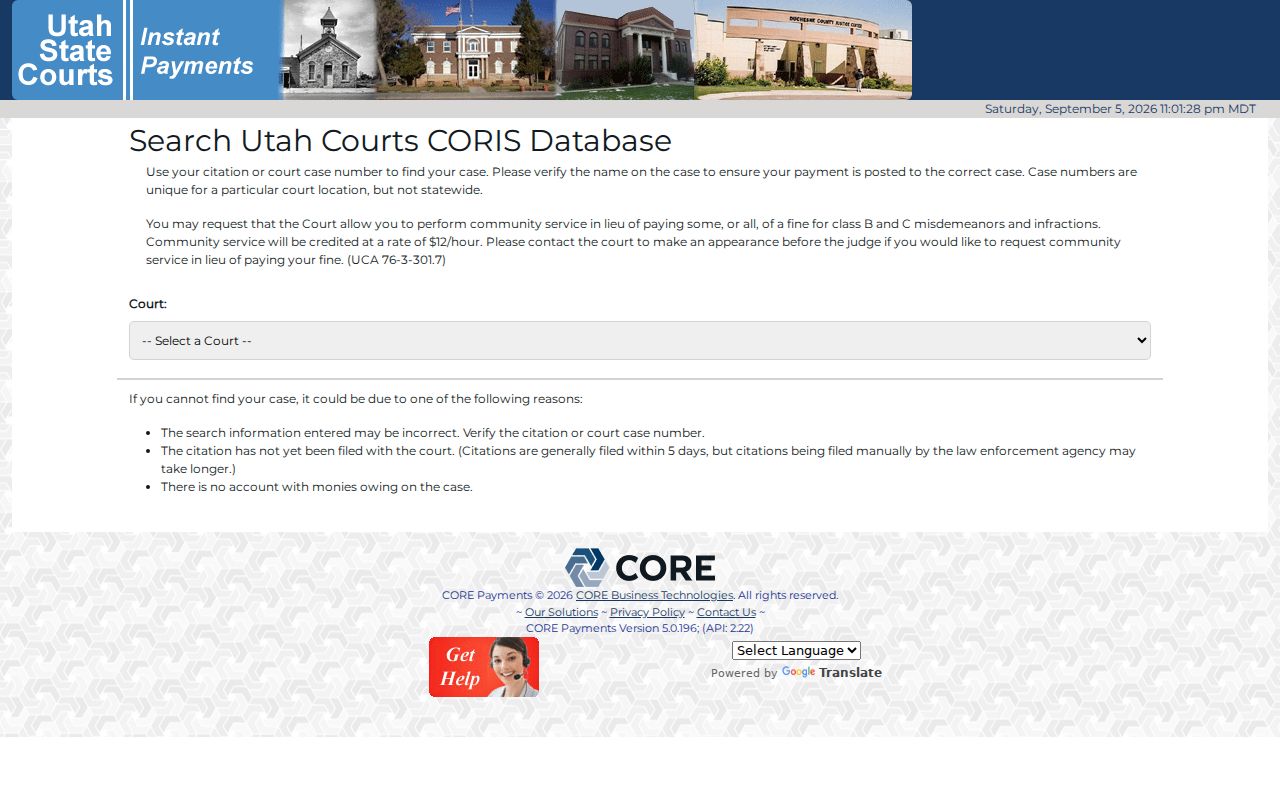
The court dropdown keeps the Myton, Altamont, or county connection from being mistaken for the real filing location. For the full history of charges, pleas, settings, judgments, and outcomes, move from Core to XChange or the clerk. The county Traffic Court page covers how to respond and get copies.
Altamont Court Case Code Shortcuts
XChange case-type codes can tighten a county search when a party name is common. The official list spans traffic, criminal, civil, domestic, probate, judgment, and appeal categories. Traffic histories may carry TN or TC codes. Party codes mark roles like plaintiff, defendant, petitioner, or respondent. Trust the official code table. Guessing an expansion is a bad habit.
- Case type
- The category assigned by the court to the matter.
- Party code
- A short label defining a person's role in that case.
- Case history
- The dated index of events, hearings, filings, and outcome.
- Document link
- An available public image for purchase, not a feature on every entry.
Once you find a match, write down the location and the complete case number. Those two facts route every later copy and calendar request.
How Altamont Cases Reach the County
Altamont's town hall keeps the local ordinances and its own administrative papers. Anything judicial leaves town. A low-level matter lands in the Justice Court named on the citation or notice, while general-jurisdiction cases and Justice Court appeals go to District Court. Juvenile Court alone handles most youth matters, and it keeps those files tightly restricted.
Docket flow: Altamont town issue › Duchesne County Justice Court when named › Utah District Court on appeal or for district-level jurisdiction
Treat this as a routing map. It is not a promise that every Altamont case walks the same road. The citation, the summons, and the XChange result govern. When a Justice Court judgment moves up on appeal, keep the lower-court case number. Then run a second docket search at the district level. The county's court docket overview lays out the fuller hierarchy.
Altamont Court Access Channels
Online tools split the work. XChange carries public case histories. Full Court Calendar shows court dates. Core serves a numbered Justice Court payment account, and MyCourtCase opens a party's own file. Offline, the right clerk can help by phone, email, or mail. You can inspect papers in person, use a public terminal where one exists, or send a written Utah Judiciary record request. Some historical records sit with Utah State Archives instead.
For contacts, Duchesne County Justice Court lists 799 E 1260 N, Duchesne, UT 84021. Its mailing address is PO Box 15. The phone is 435-738-0109, and the email is jcduchesne@utcourts.gov. The District numbers are 435-264-4700 for Duchesne and 435-722-0235 for Roosevelt. Ask which location owns the Altamont-connected file before you drive there or mail a payment.
Altamont Appeals Change the Docket
A Justice Court judgment can be appealed to District Court for a fresh hearing or trial under Utah procedure. That step changes nearly everything. The court level shifts, the clerk holding the file changes, and so does the calendar. The case identifier usually changes too. So a citation search at Justice Court may show only chapter one.
Work the chain. Pull the Justice Court history first. Note the judgment and any appeal entry. Then search XChange within District Court under Duchesne County. If the online trail has gaps, ask both clerks which papers sit in each file. This two-level check beats a bare search for "Altamont" every time.
Who Can See Altamont Court Records
Any person may inspect a public Utah judicial record. Case and document classifications still decide what is actually open. Private, protected, sealed, juvenile, and expunged files follow separate rules. Seeing a party's name in public does not unlock a restricted paper. Request a specific case event or document. Cite your authority if you want non-public material.
Utah access rules:
UCJA 4-202.02 classifies judicial records.
UCJA 4-202.03 defines public and special access.
UCJA 4-202.04 governs written requests and classification.
Keep town and court channels separate: Altamont's GRAMA or public-notice process cannot override judicial classifications, so send any court-record request to the court responsible for the file.
Verify an Altamont Court Record
Verify against the source that created the fact in the first place. For an ordinance, town meeting, office contact, or local administrative record, use Altamont's official site or its Public Notice profile. XChange answers for public case histories, and Full Court Calendar answers for scheduled judicial events. A certified paper, audio recording, transcript, access ruling, or the location of an older file is another matter. Ask the holding court directly for those.
A failed name search usually means a failed search strategy, not a missing case. Check the spelling, first-name variations, jurisdiction, case type, county, location, and date range. Cast the net too wide and you can blow past the 500-result limit. Cast it too narrow and you may miss a case filed at a different court location. Case numbers are not unique statewide, so pair every number with its county and court. Even perfect search terms will not surface a sealed, expunged, juvenile, private, or protected record.
Traffic lookups carry their own timing risk. Core warns that citations take about five days to appear, and manual entry can lag longer. The county payment hub says electronic credits need three to six working days. Hold onto the paper citation and the payment receipt. A blank result or a slow balance does not move the deadline. Call the court printed on the ticket instead of paying twice or letting an appearance date slip by.
A written Utah Judiciary request should name the case, the location, the parties by role, and the document. Add the entry date and the copy type you want. Inspection of public records is free. Paper copies run $0.25 per sheet. Certified copies cost $4 per document plus $0.50 per page, and exemplified copies $6 per document plus $0.50 per page. Staff may bill for production time past the first 15 minutes. Ask for an estimate if the request is broad.
Older Altamont-connected matters may predate full digital coverage. Most District Courts ran on CORIS by the end of 1998. Justice Courts converted on staggered schedules and did not enter old information to a uniform depth. Records more than 50 years old may now live at Utah State Archives. Ask both the creating court and Archives before treating an empty XChange result as proof that no file exists.