
Duchesne County Criminal Docket Searches
Utah Courts XChange is the public doorway to case histories. Those histories live in CORIS, the state court system. A guest login works; a registered account works too. Type a defendant name or case number. Then check the court and the case-type code so you land on the right file. Felonies and class A misdemeanors are heard at the District Court benches in Duchesne and Roosevelt. The Justice Court takes class B and C misdemeanors, infractions, traffic tickets, and local ordinance cases.
Do not confuse XChange with eFlex, the filing portal for attorneys and other authorized filers. It is also not the free Utah court calendar. That tool serves a different need: a search by date. A solid Duchesne County criminal docket search leans on the case history for sequence. It uses the calendar to verify the next hearing.
- Choose District or Justice Court from the court named on the charging paper.
- Search XChange by name or case number and compare the location and filing date.
- Open the case-number link for extended case history and minute entries.
- Read charges, plea, settings, disposition, and account entries as separate fields.
- Confirm a future date in the calendar or with the assigned court clerk.
- Request the filed document or certified copy when the history is not enough.
Duchesne Criminal XChange Controls
The official XChange help screen explains the numbered search controls that walk you through finding and opening a case history.
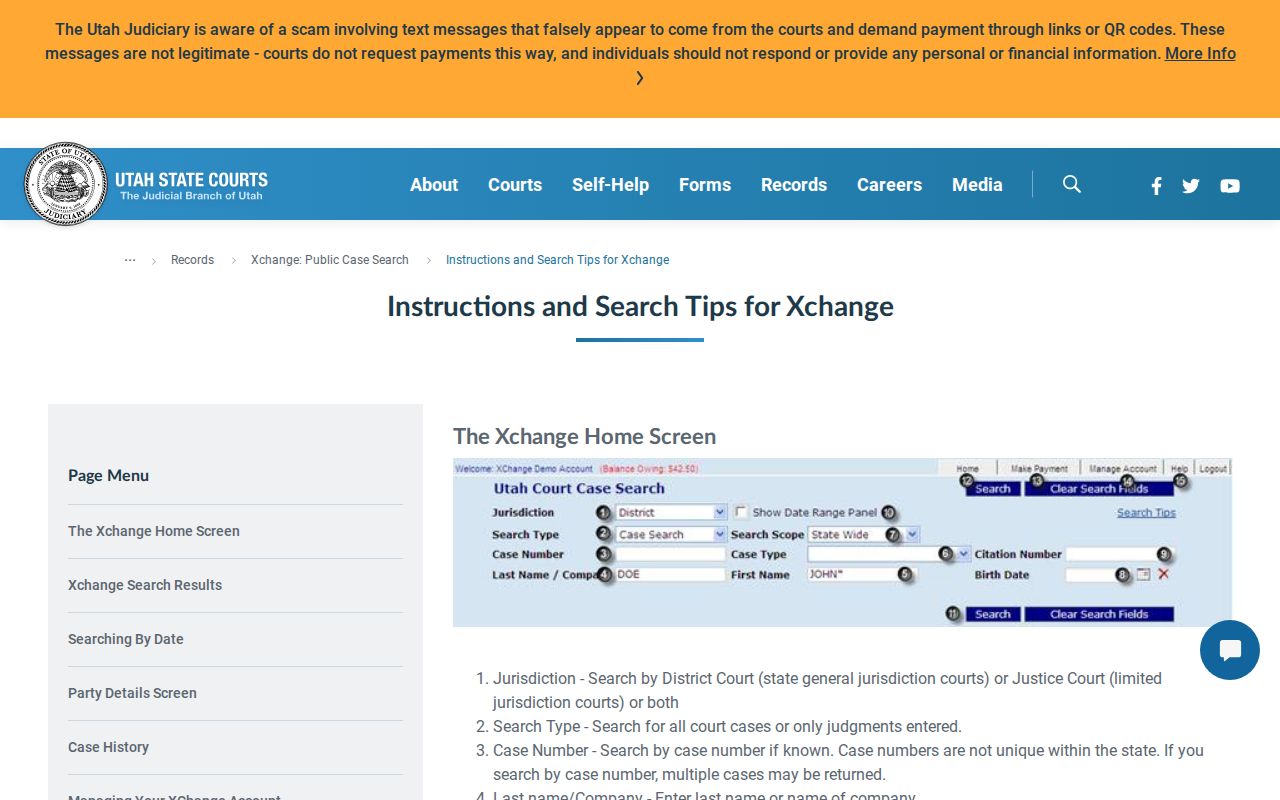
The controls worth learning are simple. They are search type, court location, party name, case number, and case type. Results can top out at 500. Trim a wide name search by picking one court and weighing the filing dates. When a case fails to appear, it may be new or restricted. It may have been filed in another county, or be older than the converted records. That empty result is not proof the case never existed.
Criminal Dockets: What They Show
A criminal case history in Duchesne County comes in layers. The header carries the court, location, caption, filing date, judge, case type, and status. Below it, the charge block lists each offense. Each one shows its Utah classification, severity, and any special attributes. The proceedings then run as a dated log of appearances, motions, minute entries, and rulings.
| Case type | FS state felony, MO other misdemeanor, MD misdemeanor DUI, or IF infraction. |
|---|---|
| Charge block | Offense, classification, agency, officer, prosecutor, citation, and violation date when available. |
| Settings | Date, time, location, judge, and labels such as arraignment, pretrial, or jury selection. |
| Plea | The plea type and date, read apart from the final disposition. |
| Disposition | The recorded resolution and date; the signed order controls exact terms. |
| Account | Fines, fees, paid sums, balance, and due dates where entered. |
| Documents | A Purchase or Available link when an electronic public image exists; $1 per document. |
Duchesne Plea and Disposition Dates
A plea date is not the same thing as a disposition date. Arraignment is where the court reads the charge and takes a plea. Plead not guilty and the case usually heads to a pretrial conference. There the prosecutor and defense may talk terms, though no deal is promised and a judge can turn one down. Left unresolved, the case goes to a bench or jury trial. The Justice Court describes a four-person jury when that option applies.
A plea in abeyance holds a guilty or no-contest plea while conditions run their course. So it is neither a final conviction entry nor a dismissal. Keep the motions and orders straight too. A motion asks the court to act, and an order records what the judge decided. Read all the way to the last judgment, sentence, probation review, payment, warrant, appeal, or closure entry.
Criminal Case Stages on the Docket
Justice Court cases open with check-in and arraignment. Counsel can be requested at that first appearance if eligibility allows. A not-guilty plea sends the case into pretrial work. That work can end in a plea or a trial. Sentencing may follow a guilty finding the same day or come later on its own. Felony files in District Court add stages. Those stages are initial appearance, preliminary hearing, bind-over, motions, and probation review.
Docket flow: Filing › Arraignment › Pretrial › Plea or Trial › Disposition › Sentencing
A reset moves a hearing; it does not dismiss the charge. Check proceedings against the Utah Courts calendar, refreshed weekdays at 5:30 a.m. Verify any virtual-hearing label with the judge's team, and note that UCJA 4-401.02 forbids recording or transmitting proceedings.
Duchesne Criminal Process in Practice
The county's criminal-process page lays out arraignment, pretrial, trial, and sentencing.
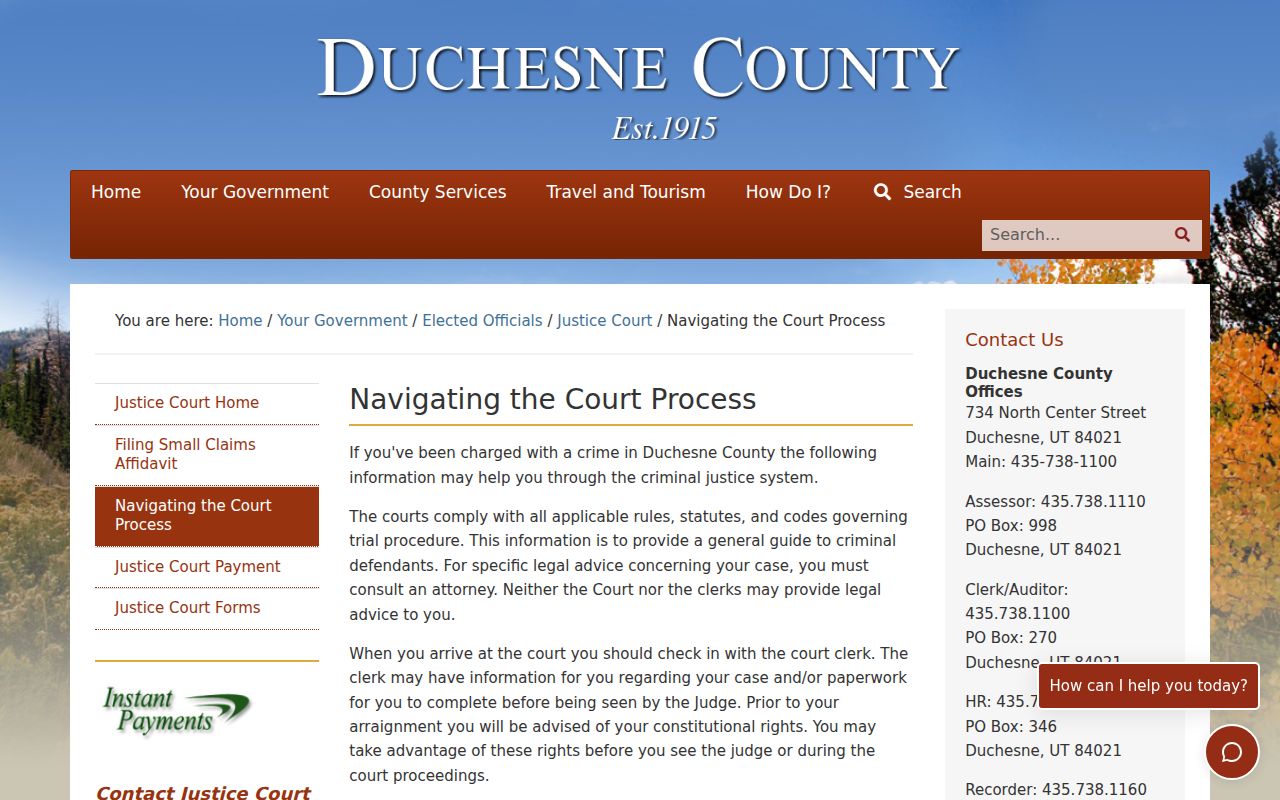
Broad maximum ranges for lower-level offenses appear on the page, but the statute and the current Uniform Fine Schedule govern a live case. Fines, fees, payments, and the balance show up in the account summary. That summary will not spell out every sentence term. For that, pull the signed judgment or sentencing order.
Duchesne County Criminal Docket Courts
Utah District Court is the general-jurisdiction court. Cases are assigned to 21554 W 9000 S in Duchesne or 255 South Street in Roosevelt. Duchesne lists 435-264-4700 and Roosevelt 435-722-0235. Eighth District records routing offers 435-738-2753 plus 8duchd@utcourts.gov or 8roosd@utcourts.gov. Check where the docket sits before calling or mailing.
Duchesne County Justice Court sits at 799 E 1260 N, Duchesne, reachable at 435-738-0109 and jcduchesne@utcourts.gov, with appearances scheduled ahead. It is not a court of record. Because of that, appeals go to District Court for a fresh trial or hearing under Utah Code §78A-7-118 and Rule 38. Juvenile Court runs on its own restricted system.
Duchesne Pretrial and Probation Entries
The 2024 Utah Judicial Council report credits the Duchesne County Sheriff's Office with resources for pretrial-release and probation supervision. That support can shape a criminal case history. Entries may involve release conditions, review dates, compliance, testing, probation terms, or later disposition work. The program creates no separate public specialty-court docket. Search the underlying District or Justice Court case itself.
Treatment resources remain a challenge across the Eighth District, the report adds. A short event label tells you little. The facts behind a compliance review or probation action live in the minute entry and the signed order. Read those papers. When XChange does not offer what you need, request it from the court location that holds the file. A supervision entry alone does not change the recorded disposition.
Duchesne Criminal Records Fallbacks
Online tools are one channel. Parties get free MyCourtCase access to linked filings and case history. Anyone may also visit the proper District or Justice Court counter for a public record. Terminal access is worth confirming first. A call or email confirms the right location. A mailed request should state the case, the parties by role, the document, the date, and the copy type.
When no image appears, submit the state Request for a Record form under UCJA 4-202.03 and 4-202.04. Inspection is free. Paper copies cost $0.25 per sheet. Certified copies run $4 per document plus $0.50 per page. The usual response comes within 10 business days. Records older than 50 years may live at the Utah State Archives, while County GRAMA stays for county-government records rather than state court files.
Give the clerk enough to locate the item: name the court, the approximate filing date, the public case number if known, party roles, and the exact document. State whether inspection, a plain copy, or a certified copy will serve. Do not expose needless personal data. Hearing audio takes a separate Eighth District route. The district form lists $15 for a CD or MP4 covering up to four hours. Mailed copies add $2.80 postage. Those charges differ from a written docket entry or certified judgment fee.
Access Rules for Criminal Dockets
Utah presumes public access, but record classification still controls what a criminal docket shows. Sealed and expunged cases do not display. Juvenile delinquency, child-welfare, and termination matters follow separate rules entirely, and a brand-new case may not be entered yet, while an old Justice Court file can predate full CORIS conversion. The clerk explains the route but not protected facts.
Key rules:
UCJA 4-202.02 defines public, private, protected, safeguarded, juvenile, and sealed records.
UCJA 4-202.03 states who may access public and certain non-public records.
UCJA 4-202.04 governs written access and classification requests.
The online history is not a certified judgment. Read the filed order as well. Obtain certification from the court when exact terms matter. The broader Duchesne County docket search lays out name and case-number routes across court types.