
Duchesne County Civil Docket Searches
The main tool is Utah Courts XChange, which opens the public case history for District and Justice Court cases entered in CORIS. Type in a party or case number. Then narrow the court location and compare the filing date and case type. Contracts, debt collection, property rights, torts, probate, domestic cases, writs, and liens all travel through District Court. Judgment work travels there too. Small claims start in Duchesne County Justice Court.
Costs differ by route. Guest and registered XChange access carries account and search fees. The Utah calendar is free, but it shows settings rather than the full filing history. MyCourtCase costs nothing for parties and authorized users. It is not a public research portal. eFlex handles authorized filing, not civil docket viewing.
- Select District Court or Justice Court based on the claim and paperwork.
- Search XChange by party name or case number, then narrow the location.
- Open the case-number link and verify the caption, type, filing date, and status.
- Read service, filings, motions, orders, settings, and judgment in date order.
- Check the Utah calendar for a current or future hearing.
- Ask the correct clerk for an absent image, filed order, or certified copy.
Duchesne Civil XChange Controls
The official XChange help view identifies the search controls and case-history link.
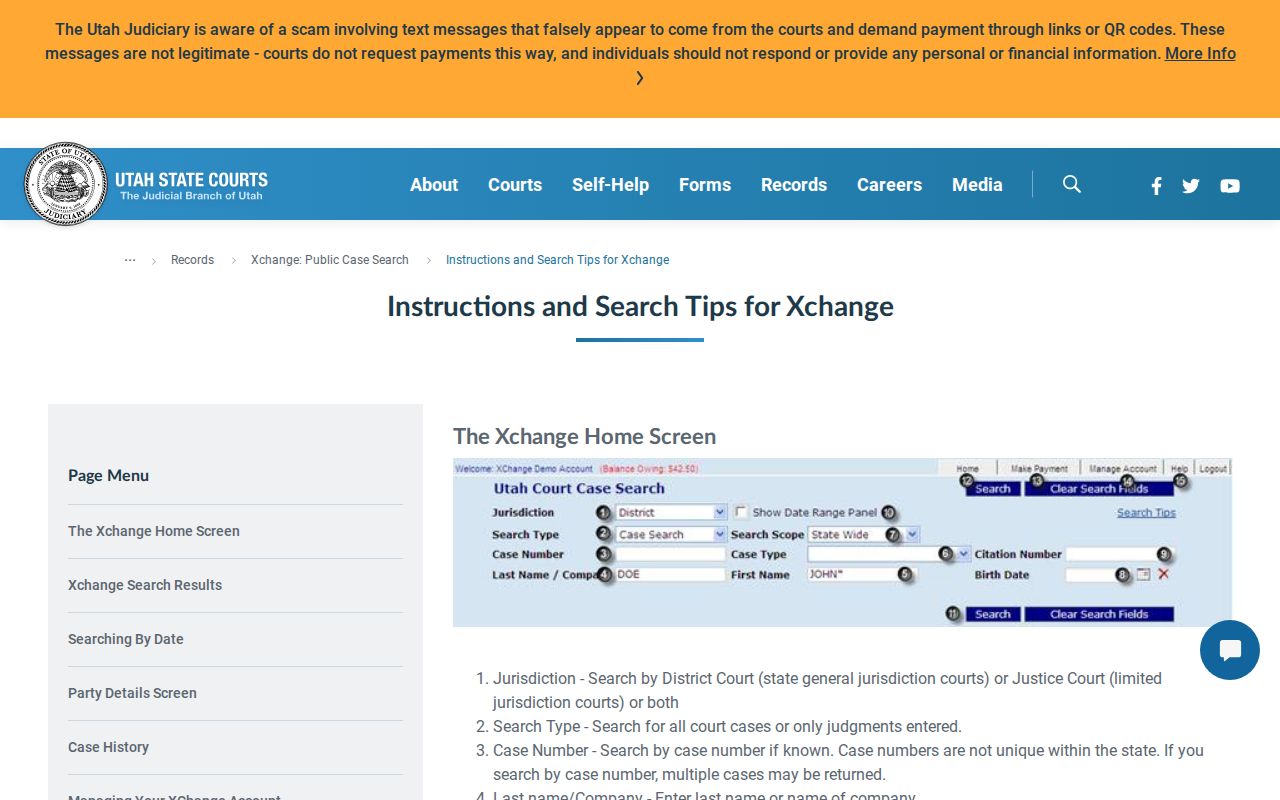
Exact details beat broad ones. A wide search can hit the 500-result maximum fast. Name order alone never proves a person's role. Two nearly identical captions may be different cases entirely. Match the court, the filing date, the case type, and the party codes before trusting a hit. Entries appear only after court staff enter them in CORIS, so a very fresh filing may not show up right away.
Civil Dockets: What They Show
The header tells you where you are: court, case number, filing date, case type, caption, judge, and status. Party lines carry short codes. The attorney usually sits beneath the party represented. From there, the proceedings run in order from complaint through post-judgment work. One caution matters. The docket is only an index and history. A filed image or a certified judgment is a separate record you must request.
| Parties | PLA plaintiff, DEF defendant, PET petitioner, RES respondent, or INT intervenor. |
|---|---|
| Case type | Codes may mark contracts, debt, property, tort, stalking, eviction, probate, domestic, judgment, or writ matters. |
| Proceedings | Complaint, service, answer, counterclaim, motion, notice, hearing, order, judgment, appeal, and enforcement events. |
| Account | Filing fees, costs, judgment sums, payments, and balance where entered. |
| Due dates | Continuing filing duties, especially in guardianship or conservatorship cases. |
| Documents | Public images when available; otherwise a request to the court clerk is needed. |
Duchesne Civil Roles and Codes
Party codes stop a common mistake before it starts. PLA and DEF mark plaintiff and defendant, while PET and RES usually signal petitioner and respondent. Probate adds DEC for decedent and HER for heir. Guardianship matters may show GAL for guardian ad litem or CON for conservator. GAR or GDF names a garnishee. Read the caption and the role code together, and skip the guessing from name order.
Case codes matter just as much. CN is contracts, DC debt collection, PR property rights, and TA automobile tort. SK covers civil stalking, EV eviction, WR writs, and LM lien or mortgage foreclosure. AJ marks an abstract of judgment. ST flags a small-claims trial de novo in District Court after a Justice Court appeal.
What Cases Fill the Civil Docket
The civil docket in Duchesne County mirrors the Uinta Basin itself. It covers homes, land, commerce, family matters, and estates. District Court serves as the general-jurisdiction venue for that mix. A public code table lists a broad range of civil categories. Still, the court named on the filed paper controls the actual route. Let that document settle any question. It answers where a case runs.
- Contracts, debt collection, foreign judgments, and judgment enforcement.
- Property rights, liens, mortgage foreclosure, and writ proceedings.
- Personal injury and automobile tort claims.
- Probate, guardianship, conservatorship, and estate matters.
- Domestic relations and civil stalking cases, subject to privacy rules.
- Small claims and lower-court matters assigned to Justice Court.
Money limits deserve care. The current Duchesne small-claims form sets a $15,000 cap with filing brackets of $60, $100, and $185. An older XChange description still lists $10,000. Trust the current form and statute over the stale portal text, and confirm venue before you file or search.
Duchesne Motions Are Not Orders
A motion is a request, nothing more. Its presence on the docket does not mean the judge granted anything, so look for the response, the hearing, the minute entry, and the signed order. The same caution runs through the whole docket. A complaint is not proof of service. A hearing setting is not proof the hearing took place. A judgment is not proof it was satisfied. One question in a civil case often takes several linked entries to answer.
A typical sequence runs complaint or petition, citation and service, answer, discovery, motions, notice of setting, hearing, order, and judgment. After judgment, expect entries like an abstract, execution, garnishment, writ, payment, satisfaction, or appeal. The latest signed document will always say more than a short event label.
Duchesne Civil Filing Context
Watch the source on filing numbers. The FY2023 figures come from the 2024 Judicial Council report. They cover the whole Eighth District, not Duchesne County alone. Across Daggett, Duchesne, and Uintah Counties, domestic filings ran 10.9% above the ten-year average. Protective-order filings rose 51.6%. Civil-stalking requests climbed 48.1%, and probate filings grew 17.1%. These are district-wide facts. Treat them as context, never as Duchesne-only totals.
That mix explains why one civil search may cross domestic, stalking, probate, property, contract, or debt codes. It also underlines the need to check privacy classification before asking for an image. Rising filing categories leave the public-access rules untouched, and a district-wide trend says nothing about how one case ends.
Hearings on the Civil Docket
Every hearing entry in the docket history carries its own details. XChange lists the date, the court, the judge, and an event label. For a second check, the Utah Courts calendar lets you search by case number, party, judge, attorney, date, or location. Weekday updates land at 5:30 a.m. One empty day proves nothing. A no-result page does not mean the case is closed or that it never existed. Settings also differ. Status, motion, settlement, case-management, and trial settings each do a different job. A continuance only moves a date, and it never decides the dispute. Before you rely on a listing, confirm the current setting with the clerk or the judge's team. That matters most when the calendar says Virtual Hearing. Public attendance may be allowed, but UCJA 4-401.02 bars recording, photographing, or transmitting a proceeding. For a date-first lookup, try the Duchesne County court schedule.
Duchesne Civil Case Type Table
The official XChange case-type table distinguishes civil, probate, domestic, judgment, and related codes.
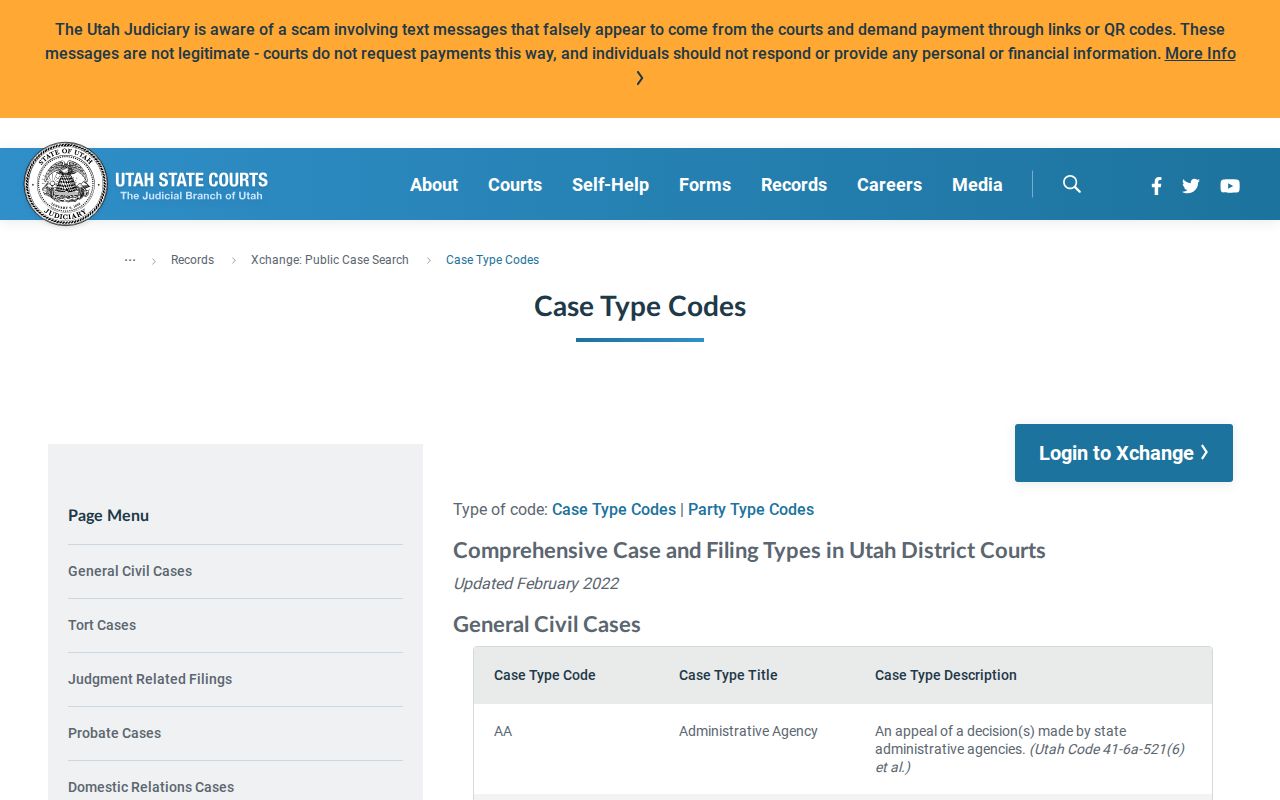
Case-type codes describe the filing category, nothing more. A debt code does not equal a judgment. A judgment code says nothing about payment. To learn what actually happened, read the proceeding list and the filed order. The public case-type table stops short of local outcome labels, so ask the clerk whenever an unfamiliar code appears on a Duchesne County civil docket.
Duchesne Civil Clerk Channels
Match the court to the location printed on the docket. Duchesne District Court sits at 21554 W 9000 S, Duchesne, phone 435-264-4700. Roosevelt District Court sits at 255 S State, Roosevelt, phone 435-722-0235. Eighth District records routing gives one shared line, 435-738-2753. It also offers two emails: 8duchd@utcourts.gov and 8roosd@utcourts.gov. Duchesne County Justice Court sits at 799 E 1260 N. It is reachable at 435-738-0109 and jcduchesne@utcourts.gov.
The clerk works by counter, phone, email, or mail. Use the state's Request for a Record form. Describe the case and the document with reasonable detail. Looking is free. Paper copies run $0.25 per sheet. Certification adds $4 per document plus $0.50 per page. Most responses arrive within 10 business days. Court series older than 50 years may sit with the Utah State Archives. County GRAMA requests reach county administrative records, not state court files.
Justice Court small claims bring extra tools. These include the Justice calendar, court forms, online dispute resolution, and the Core payment route. An appeal there triggers a District Court trial de novo. That means a new hearing rather than a review limited to the lower record. Trace that appeal by searching the ST case type in District Court. Court-reporter audio sits apart from both the civil case history and a filed-paper request.
Who Can See Civil Dockets
UCJA 4-202.02 sets the record classes for Utah courts. A civil case history can stay public. Its filed documents may not. XChange marks domestic subjects that may contain private records, a list covering divorce, custody, paternity, cohabitant abuse, guardianship, conservatorship, and civil stalking. Hearing minutes, judgments, orders, decrees, and letters of appointment generally stay public unless a court orders otherwise.
Public access rules:
UCJA 4-202.02 defines public and non-public record classes.
UCJA 4-202.03 provides access to public court records.
UCJA 4-202.04 provides the written request and classification process.
Missing images are common. XChange can lack an electronic image even when the paper file is fully public. Ask for the specific pleading or order. Don't assume a seal. For a private record, you must state your access basis and supply proof when the clerk requires it. A certified judgment must come from the clerk, never from the docket summary alone.