
Duchesne County Court Record Requests
First, figure out which court holds the file. Staff at the Utah District Court in Duchesne or Roosevelt keep the district civil, domestic, probate, felony, and other court-of-record files. The Duchesne County Justice Court clerk handles class B and C misdemeanor, infraction, traffic, ordinance, and small-claims files. Juvenile Court runs its own restricted records system. The elected County Clerk/Auditor keeps county business records, not court files.
Several access channels are open. Search public case history in Utah Courts XChange. You can also ask at the correct court counter about inspection or a public terminal. A call or email confirms custody and submission details. You can also mail a written request. Alternatively, submit the state Request for a Court Record under Utah court rules. The statewide calendar confirms a setting, though it is not a full case file. Note that the County GRAMA form covers county-government records, not the normal state-court route.
- Identify the court location, case number, parties by role, and exact document title or date.
- Check XChange for the public case history and an available document-purchase link.
- For an absent image, contact the holding court in person, by phone, email, or mail.
- State whether inspection, a plain copy, certification, exemplification, audio, or a transcript is needed.
- Submit any access authority for a non-public record and pay the quoted copy or staff-time charge.
Duchesne Case History Is an Index
A case history is an index, not the whole file. XChange can show a lot. Parties, the assigned judge, attorneys of record, document labels, hearings, judgments, accounting entries, and the outcome of a completed public case all appear there, and an extended version adds minute-entry detail. That timeline is useful. It helps you name the exact order, motion, or judgment to request from the clerk.
The underlying complaint, petition, answer, exhibit, signed order, or transcript is a separate object. Some public electronic documents carry a Purchase or Available link. Some do not. Utah Courts says electronically filed public District Court documents dating from July 2010 may be offered, but no image is promised for every event or case type. When no link appears, take the court-record request route. Do not assume the paper never existed.
Key distinction: A case-history entry proves that an event was logged. It does not guarantee that the underlying document can be viewed online.
Kinds of Duchesne Court Records
Duchesne County court records sort by case type and by record form. District files may hold a lot. Civil, domestic, probate, criminal, judgment, and appeal material can all appear in them. Justice Court files cover lower-level criminal, traffic, ordinance, infraction, and small-claims matters. Access turns on classification. The case and each document matter, not just the broad case label.
- Case histories and chronological entries showing filings, settings, rulings, and disposition.
- Pleadings, motions, notices, exhibits, orders, and judgments filed in a public case.
- Plain, certified, or exemplified copies prepared for different uses.
- Hearing audio, video, and transcripts ordered through separate court channels.
- Historical minute books, registers of actions, docket books, and judgment books.
Domestic case history can be public while a paper beneath it stays private. Juvenile material, sealed cases, expunged cases, and protected data all require specific authority. No public search result overrides the classification set under Utah judicial-record rules.
Duchesne Hearing Audio Requests
A filed paper, a hearing recording, and a transcript each travel a different path. The Eighth District audio form wants several details. Provide the case caption, case number, hearing date, judge, courtroom, time, your contact details, and preferred delivery. Duchesne requests go to 8duchd@utcourts.gov. Roosevelt requests go to 8roosd@utcourts.gov, and the shared records-routing line on the form is 435-738-2753.
- Audio or video
- The court's recording of a proceeding, priced by the stated time block or delivery format.
- Transcript
- A written record prepared through the reporter or recording channel, with per-page charges.
- Filed document
- A paper accepted into the case file, sometimes sold as an XChange image.
- Case history
- The chronological index of events and entries, not a verbatim hearing record.
Costs differ by source. The general Utah page lists electronic audio or video at $15 per half-day of testimony. The Eighth District form lists $15 for an emailed MP4 covering up to four hours. Mailed copies cost $15 per CD plus postage. Confirm format and duration before paying, since those measures differ.
Duchesne Court Records: What They Contain
Read a Duchesne County court file in layers. Start with the case identifier and location. Then trace the case-event sequence. XChange warns that case numbers are not unique statewide. County and court location matter. Party codes such as PLA, DEF, PET, and RES explain a person's role. Entries then tie together the filed papers, hearings, orders, judgment, and completed-case outcome.
| Case identity | County, court location, case type, case number, and filing date. |
|---|---|
| Parties | Names, party-role codes, attorneys, and limited public detail when entered. |
| Case history | Dated events, hearings, minute entries, filed-document labels, and disposition. |
| Orders and judgments | Rulings and judgment entries, with an image link only when a public document is available. |
| Accounting | Public account information associated with the court case when applicable. |
The public inventory may leave out protected personal data, private documents, or exhibit content. Cite the exact entry date and document label instead of asking staff for an undefined "whole record." A precise request is easier to classify, locate, price, and fulfill.
Older Duchesne Court Case Records
The Utah State Archives Eighth District guide marks where record access changes. The Eighth District formed in 1988. Most District Courts had adopted CORIS by the end of 1998. Justice Courts converted at different times and chose how much older material to enter. That is why an old Justice Court search may look sparse. Even so, a paper file or archival series survives.
Records more than 50 years old may sit at the Archives. Ask the creating court. The file may remain local, exist on microfilm, or have been transferred as a named series. Archives descriptions cover minute books. They also cover registers of actions or docket books, and order or judgment books. Historical and genealogy research works best with a court name, time span, party name, record type, and any known series number.
Note: A blank XChange result is not proof that an older Duchesne County court record never existed.
Copy Fees and Certification
Think about how you will use the copy before you order it. A plain copy works fine for reading a file. It also suits keeping tabs on your own case. Certified copies carry the court's seal. They are typically demanded when an order or judgment goes into a formal process. Exemplified copies add a still higher level of authentication. When in doubt, ask the receiving office which form it wants. Looking at a public court record at the courthouse costs nothing. Charges for staff time and production can still apply.
What about current certification charges? The official Utah Courts fee schedule lists the amounts the clerk will quote. The page sets out the statewide fees. Those include the ones most relevant to Duchesne County copy requests.
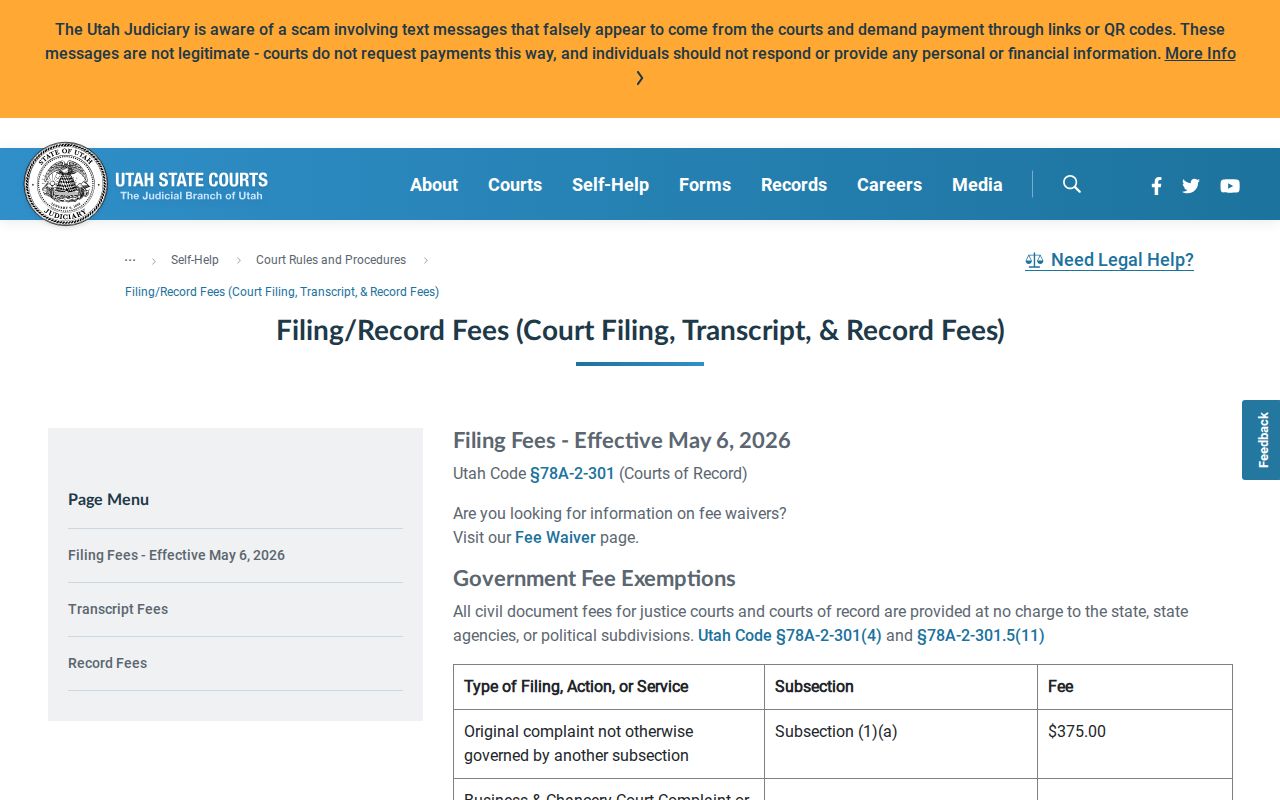
The price gap matters here. A cheap XChange image is fine for reference, but a clerk-certified copy is what a formal recipient expects, so settle that question before you hand over payment in Duchesne County.
| Record service | Official amount |
|---|---|
| Inspect a public court record | No charge |
| Paper copy | $0.25 per sheet |
| XChange document image | $1 per document |
| Certified copy | $4 per document plus $0.50 per page |
| Exemplified copy | $6 per document plus $0.50 per page |
| Fax or email | $5 for up to 10 pages, then $0.50 each |
Duchesne District Court
21554 W 9000 S, PO Box 990
Duchesne, UT 84021
435-264-4700
Roosevelt District Court
255 South State Street, PO Box 1286
Roosevelt, UT 84066
435-722-0235
Written Duchesne Records Request Timing
Timing starts when the clerk gets a written request. The Utah Judiciary request instructions set the usual response window at 10 business days. That clock measures the response, not the production of an archived or complex record. So expect some patience on older files.
Fill out the form with care. It asks for a reasonably specific description of the record, whether you want inspection or copies, your contact information, any fee-waiver basis you claim, and your signature.
Staff time also has a price tag. The first 15 minutes are free of staff charges, and after that the court bills at the cheapest applicable employee rate. The published scale starts at $15 per hour for a clerk and climbs by role. Mail costs are billed at actual cost. Records already on XChange will not be faxed or emailed, so if the online image is missing, describe your failed search and name the document from the case history instead.
Access Rules for Court Records
Access to Utah court records runs on a different track than a county GRAMA request sent to the Clerk/Auditor. The governing framework is the Utah Code of Judicial Administration. Rule 4-202.02 sorts judicial records into classes such as public, private, protected, and sealed. Rule 4-202.03 gives any person the right to inspect public court records. It also spells out special access paths. Written requests and classification decisions fall under Rule 4-202.04.
Knowing a case number does not unlock everything. Sealed, expunged, juvenile, and many private domestic records stay closed regardless. Anyone asking for non-public material has to cite the authority that allows it. Supporting documents must be attached too.
Redaction is the other half of the picture. Utah's electronic-filing guidance puts the job of stripping protected personal identifiers on the filer. A clerk does not scan every uploaded paper for hidden data. What a filer leaves in can stay in.
Utah judicial-record rules:
UCJA 4-202.02 sets record classifications.
UCJA 4-202.03 defines access to public and restricted records.
UCJA 4-202.04 covers written case-record requests.
Start with the county's Docket Search to locate the case. Then narrow your written request to the exact papers the holding court controls. That order keeps requests tight and stops state-court work from landing on the wrong county desk.
Duchesne Court Copy Types
Match the copy type to the job. A downloadable image gets you quick access but carries no certification from the court. A certified copy proves a specific paper is genuine. Exemplification stacks on another layer for a recipient that demands it outright. Transcripts put spoken proceedings into writing. Audio keeps the court's own recording intact.
Resist the habit of paying for the most formal option. Confirm what the destination actually requires first. Then give the clerk the case number, document title, entry date, and copy type. Narrow requests keep Duchesne County court case record work simple. They also make the quoted fee easy to verify.